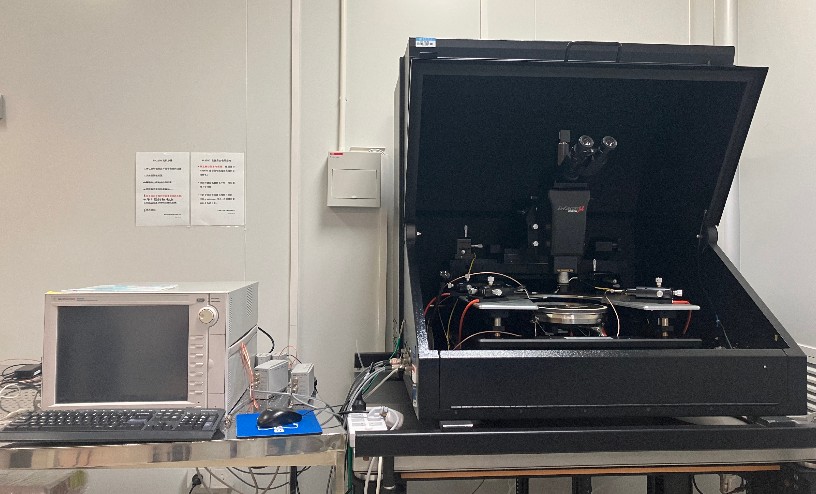
Semiconductor Parameter Tester / Probe Station
MM Probe Station and Agilent B1500A Semiconductor Parameter Analyzer
Operating
Model: B1500A
Function: DC current-voltage (I-V) measurement, pulsed IV, quasi-static and mid-frequency capacitance-voltage (C-V) measurement, time-domain measurement, etc., for semiconductor devices such as diodes, transistors and MOSFETs, as well as related materials.
Engineer: Qu / +86-21- 34207734-8003 / minni.qu@1
Location: West Area – Testing I
Equipment ID: WT1MSPA01
  • Basic Equipment Information
  • Operating Principle
  • Typical Application Case
Main Application

It supports DC current-voltage (I-V) measurement, quasi-static and mid-frequency capacitance-voltage (C-V) measurement, time-domain measurement and other tests for semiconductor devices such as diodes, triodes and MOSFETs, as well as related materials.


Process/Testing Capabilities

Temperature range from room temperature to 400℃


Technical Specifications
  • Probe Station Main Unit: Chuck XY travel range 200 mm × 200 mm; Z-axis travel range 25 mm.
  • Ball screw bearing ensures high-precision movement with a resolution of 3.5 μm.
  • Probe Manipulator: Positioning accuracy of 0.7 μm.
  • DC I-V Test: Equipped with 4-channel SMUs, including 2 medium-power SMUs and 2 high-resolution SMUs. The minimum voltage resolution is 0.5 μV and the minimum current resolution is 0.1 fA for simultaneous measurement.
  • C-V Test: Frequency range 1 kHz–5 MHz; bias voltage: ±25 V; measurement accuracy: ±0.2 % (@1 pF, 1 MHz).
  • (1) Voltage-Current Measurement (I-V Measurement):The SMU module can operate simultaneously as a current source, voltage source, ammeter and voltmeter. It applies voltage (or current) to specific ports of the device while measuring the current (or voltage) at the other terminal. The measured data is used to plot I-V characteristic curves, such as the transfer characteristics (Id-Vg) and output characteristics (Id-Vd) of MOSFETs.
  • (2) Capacitance Measurement (C-V Measurement):The CVU module adopts the small-signal AC test method, measuring the capacitance variation of the device by adjusting the bias voltage. This method is commonly used to study channel formation, charge traps and dielectric properties of MOS devices.
  • (3) Pulsed Measurement: The PGU module generates narrow pulse signals to measure the transient response of devices. This approach can mitigate current drift effects in DC testing, such as thermal effects and well charge effects.
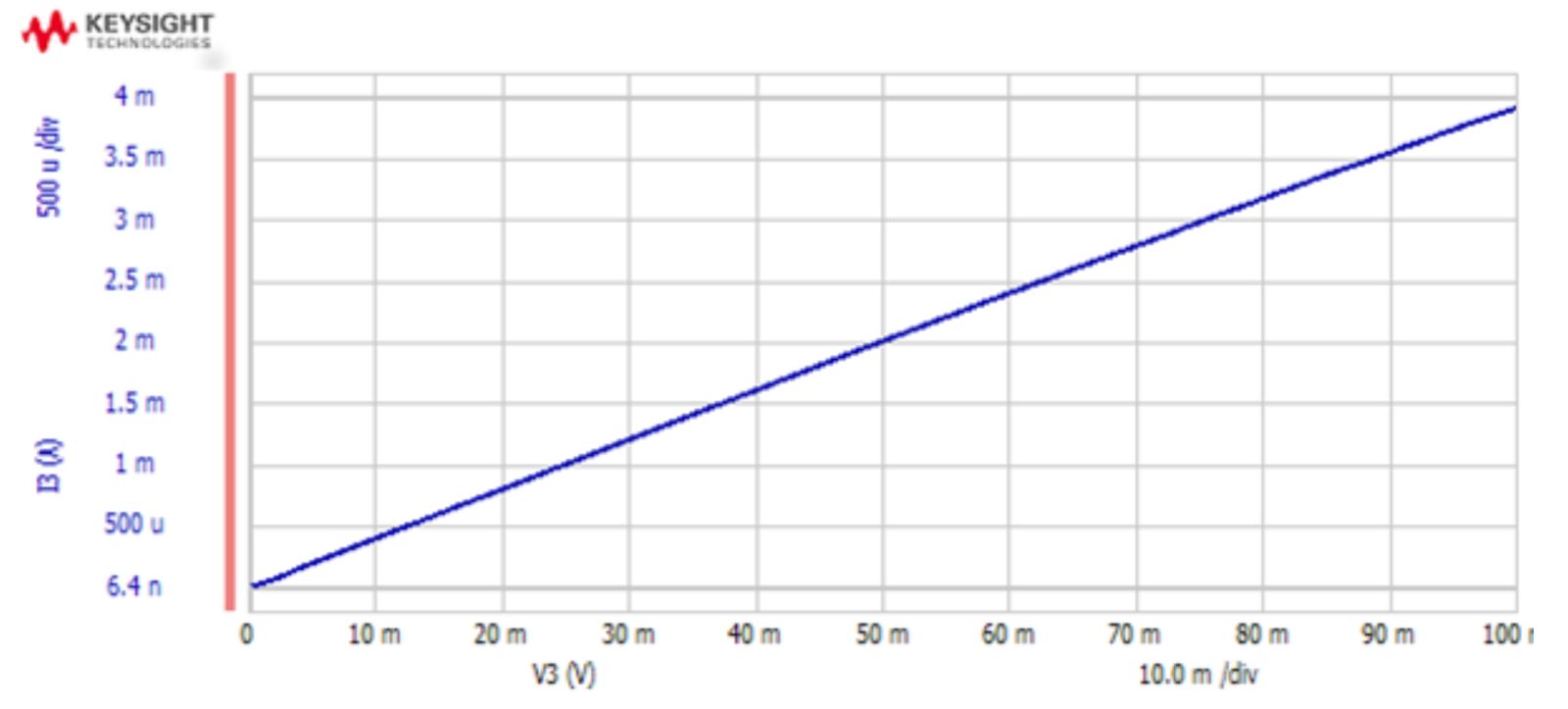
I-V Test Curve of Copper-Graphene Thin Film

Sample size: 8 inches and below.

Samples that may contaminate electrical probes (such as adhesive samples) are not acceptable.

Do not touch any cables while the system is powered on. Promptly contact the equipment administrator if probes are bent, contaminated, or in any abnormal condition.
The list below shows FAQs (click a question to view the answer). If your question is not listed, you can leave a message using the link.
FAQs
  • 01
    The test current is consistently extremely low, staying within the magnitude of 1 fA ~ 1 pA, and remains unchanged even after replacing the device under test.
    Abnormal Cause: The test loop is not conductive.

    Solutions:

    (1) When the current is close to the 1 fA magnitude, first check the cable connections. Verify whether the cable wiring is consistent with the SMU settings in the software. If cable reconnection is required, power off the equipment first and contact a process engineer for assistance.

    (2) When the current is close to the 1 pA magnitude, first check the probe contact status. Observe the contact tightness between the probes and sample electrodes under a microscope. Re-position and re-contact the probes if the connection is loose or offset.

    (3) Check the performance of the device under test. The device itself may have excessively high resistance and cannot conduct electricity. Use a conductive standard sample to verify the test loop, and contact a process engineer for support.

Message Inquiry
If your question is not listed above, please email us at [email protected] or click the button below to submit an inquiry.
Note: "@1" represents "@sjtu.edu.cn"
×