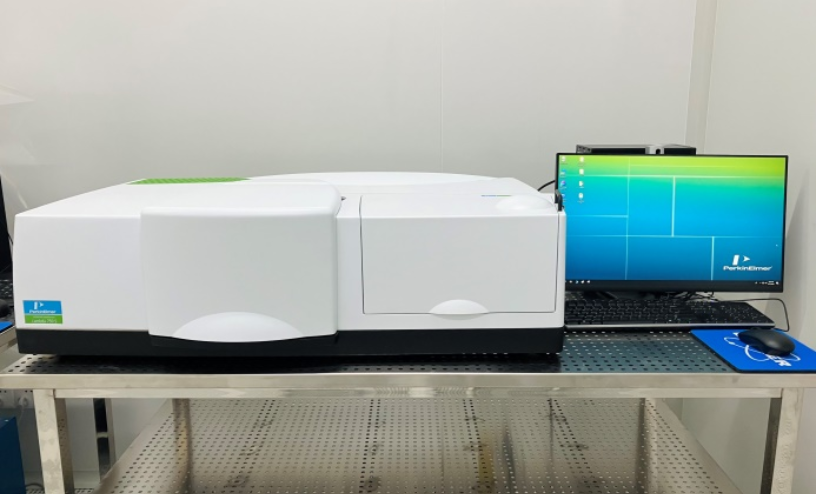
Ultraviolet-Visible Spectrophotometer
UV-vis Spectrophotometer
Operating
Model: Lambda 750S
Function: Measurement of absorbance (A), reflectance (R%) and transmittance (T%) of thin film samples in the wavelength range of 190 nm~2500 nm.
Engineer: Fu / +86-21- 34206126-6010 / xuecheng.f@1
Location: East Area – Testing III
Equipment ID: ETE3UVV01
  • Basic Equipment Information
  • Operating Principle
  • Typical Application Case
Main Application

Accurately measure the reflectance or transmittance of thin films at different wavelengths, evaluate the light transmittance, reflectivity and absorption characteristics of thin films, and determine whether they meet the design requirements of optical devices such as optical filters and solar cell films. It can also be used for process monitoring and finished product inspection in semiconductor and optical coating processes.


Process/Testing Capabilities

It is used to measure the transmission and reflection spectra of thin films. The absorption spectra in the ultraviolet-visible band can reflect information such as impurities and band gap width of thin films, and this measurement method is non-destructive.


Technical Specifications
  • Maximum wavelength test range: 200 nm~2500 nm; wavelength resolution adjustable from 0.17 nm to 5 nm
  • Wavelength accuracy: ±0.15 nm in UV-Vis region, ±0.5 nm in near-infrared region
  • Integrating sphere: 100 mm diameter PbS integrating sphere
  • Sample size: larger than 14 mm×27 mm and no more than 4 inches. For other sample sizes, please contact the equipment administrator.
The PerkinElmer Lambda 750 UV-Vis-NIR spectrophotometer adopts an optical design with dual light sources, dual beams and dual monochromators. It emits light of different wavelengths to measure the absorption, reflection and transmission characteristics of substances. After the light interacts with the sample, the detector measures the light intensity. Analytical results are then output through data processing and algorithm analysis to obtain the spectral absorption curve of the material. Featuring a wide spectral testing range, high resolution, high sensitivity and high accuracy, the instrument is widely applied in the fields of optics, coatings, thin film materials and other related areas.
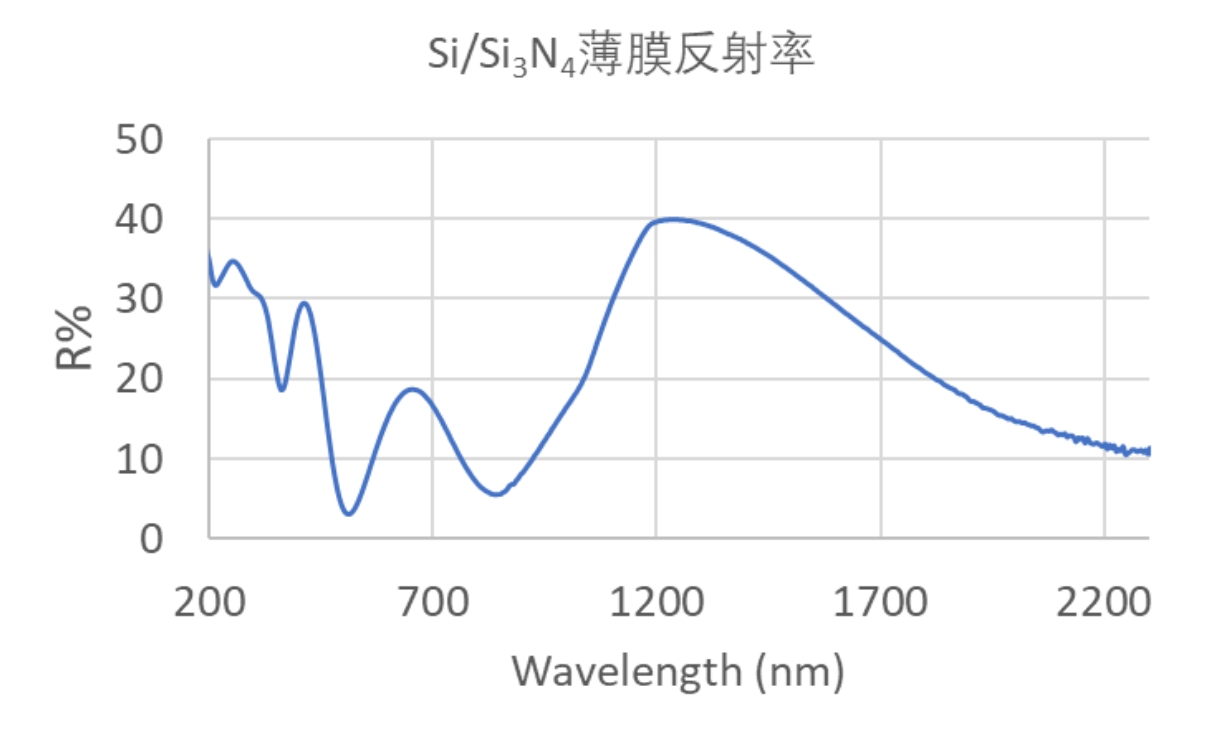
Reflection Spectrum of Si/Si₃N₄ Thin Film (Slit Width: 2 nm, Integration Time: 0.2 s):

Testing of contaminated samples such as undried photoresist and untreated powder is prohibited. The surface of test samples must be kept clean and flat. The sample size shall be larger than 20 mm×30 mm and no more than 4 inches.
1. Do not touch the prism area inside the sample chamber when loading or unloading samples.
2. Do not open the chamber during the test.
3. Keep the white reference plate clean. Wipe the area around the light aperture with a dust-free cloth after each reflectance test.
4. For reflectance measurement, place the white reference plate upside down into the black cover to avoid contamination.
5. If mold or contamination is observed on the internal prism, notify the process person in charge as soon as possible.
6. After turning off the instrument power, wait at least 5 minutes before restarting. This allows the UV lamp to cool down and extend its service life; alternatively, power off the equipment only at the end of daily operation.
7. If a software error occurs during operation, take a screenshot for record in a timely manner and contact the process person in charge.
The list below shows FAQs (click a question to view the answer). If your question is not listed, you can leave a message using the link.
FAQs
  • 01
    The white reference plate has dust or slight contamination.
    The sample surface is contaminated without cleaning, resulting in contamination of the white reference plate; the area around the light aperture is not cleaned after the reflectance test.
Message Inquiry
If your question is not listed above, please email us at [email protected] or click the button below to submit an inquiry.
Note: "@1" represents "@sjtu.edu.cn"
×