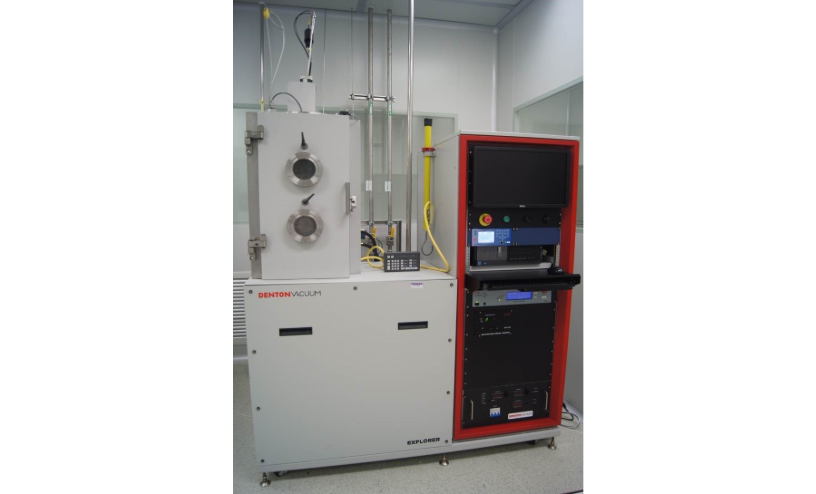
Denton Electron Beam Evaporator
Electron Beam Evaporation
Operating
Model: Explorer-14
Function: 1.Evaporative deposition of various conventional metal thin films; 2.Evaporative deposition of magnetic thin films including nickel; 3.Oblique evaporation at ±45° is achievable.
Engineer: Fu / +86-21- 34206126-6010 / xuecheng.f@1
Location: West Area – Thin Film IA
Equipment ID: WF1DEGN01
  • Basic Equipment Information
  • Operating Principle
  • Typical Application Case
Main Application

Mainly used for evaporating metal thin films such as gold, silver, aluminum, copper, chromium, titanium and nickel. It is applicable to electrode fabrication via the lift-off process and can meet the demand for thin film deposition by oblique evaporation within a 45° angle.


Process/Testing Capability

The equipment is equipped with an in-situ function for monitoring deposition thickness, supporting film deposition in the range of 1 nm to 5 μm. It can deposit a variety of metal thin films such as gold, silver, aluminum, copper, chromium, titanium and nickel. The worktable temperature is adjustable between 25 ℃ and 200 ℃.


Technical Specifications

The uniformity of 6-inch thin films is within ±3%, and the repeatability fluctuation error of fabricated film thickness is within ±2%. The deposition rates for evaporated gold, silver, copper, aluminum, titanium, chromium and nickel are all higher than 2 Å/s.
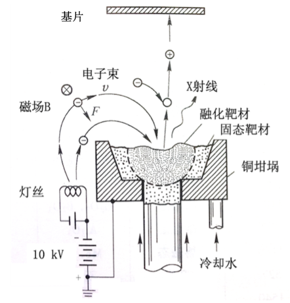
Thermal electrons emitted by the filament are accelerated and focused by the high‑voltage electric field between the cathode and anode, then deflected by a magnetic field to strike the surface of the evaporant in the crucible. The bombardment excites lattice vibration and generates heat, which melts or sublimes the material to achieve evaporative deposition.


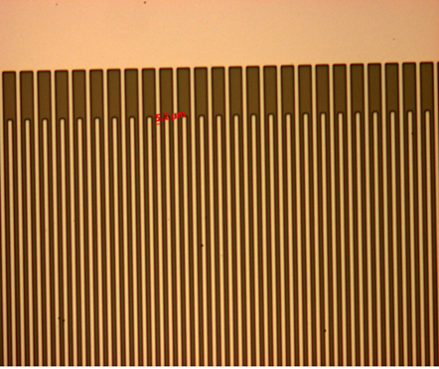
Interdigital electrodes for surface acoustic wave (SAW) devices. On the substrate after photolithography and development, a 1 μm-thick copper film is evaporated to serve as lead electrodes, and the targeted patterns are formed after the lift-off process.


1.Thick platinum films (above 100 nm) and samples larger than 6 inches are not accepted.

2.Coating is prohibited on sub-millimeter micro-particle samples.

3.Deposition of high-melting-point and highly contaminative metals including molybdenum and tungsten is not allowed.

4.Evaporated oxide films are unsupported.

5.Thick films of magnetic materials (Fe, Ni) exceeding 200 nm are not acceptable.

1.Warning: High voltage hazard during operation.

2.Cut off all power before opening the chamber.

The list below shows FAQs (click a question to view the answer). If your question is not listed, you can leave a message using the link.
FAQs
  • 01
    What causes difficult lift-off of electron beam evaporated thin films?
    This generally results in dense metal coverage, which prevents organic solvents from penetrating and dissolving the photoresist. It is recommended to attach tape to the sample edges to reserve gaps for solvent infiltration.
  • 02
    What is the regular temperature of the worktable during electron beam evaporation?
    It generally does not exceed 60 ℃.
  • 03
    How to handle splashing during electron beam evaporation?
    Lower the power setting in the program and reduce the beam current.
  • 04
    Can dielectric thin films be deposited with electron beam evaporation equipment?
    It is not feasible in principle due to difficult electron transfer.
Message Inquiry
If your question is not listed above, please email us at [email protected] or click the button below to submit an inquiry.
Note: "@1" represents "@sjtu.edu.cn"
×