| Model: | C200 |
|---|---|
| Function: | 1.Etching of dielectric thin films such as silicon dioxide (SiO₂), silicon nitride (Si₃N₄), and silicon oxynitride (SiON); 2.Etching of silicon carbide (SiC) thin films; 3.Quartz etching. |
| Engineer: | Liu / +86-21- 34206126-6013 / minliu@1 |
| Location: | East Area – Thin Film III |
| Equipment ID: | EFM3RID01 |
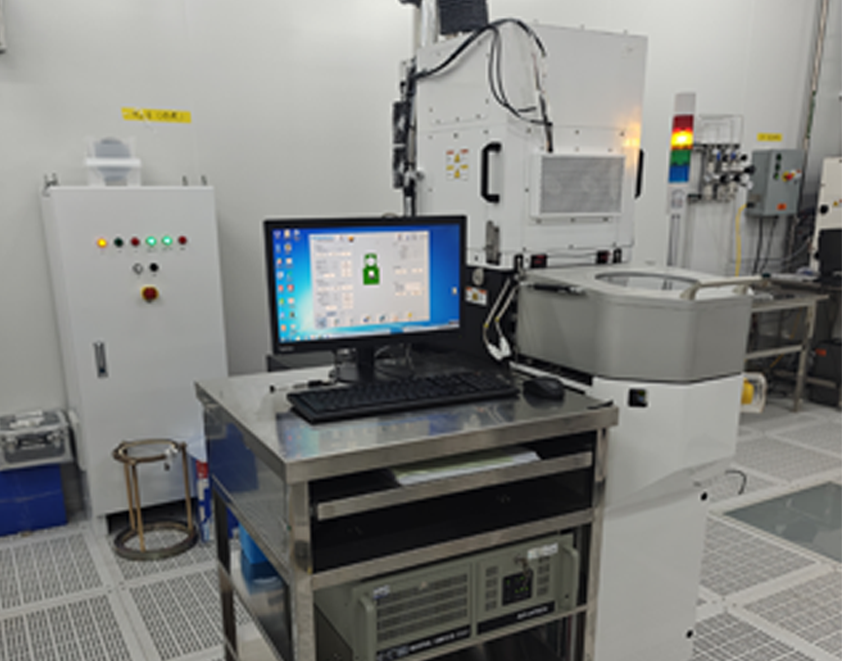
This system is mainly used for etching the following materials:
Dielectric thin films such as SiO₂, Si₃N₄, and SiON;SiC thin films;Quartz substrates.
Process / Testing Capabilities
Etch rate for SiO₂ or Si₃N₄: >200 nm/min
Selectivity to photoresist: ~2:1
Sidewall angle: >85°
Within-wafer uniformity: <5%
Technical Specifications
Designed for 8-inch wafers
ICP power: up to 1500 W
Bias power: up to 500 W
Supported etching gases: CHF₃, SF₆, CF₄, Ar, O₂, N₂
In operation, specific etching gases are introduced into the chamber. A radio frequency (RF) power source (typically 13.56 MHz) is applied to a coil located above the chamber, generating an oscillating electromagnetic field. Through inductive coupling, energy is transferred to the gas, ionizing it and generating a high-density plasma composed of free electrons and ions.
These energetic species interact with the substrate surface, enabling controlled chemical and physical etching under low-pressure conditions, resulting in excellent profile control and anisotropic etching.

Address: 800 Dongchuan Road, Minhang District, Shanghai 200240, China
Tel: +86 21 3420 7734
Email: [email protected]