Chemical Assisted Ion Beam Etching System (CAIBE)
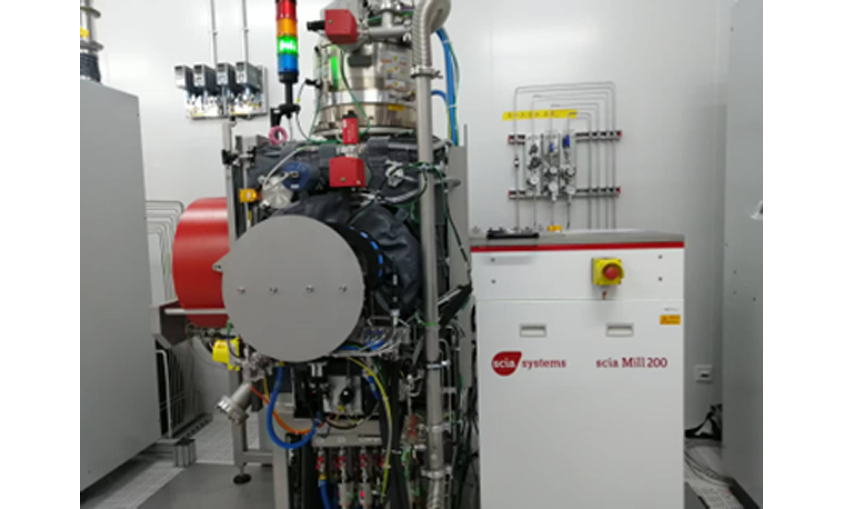
Chemically Assisted Ion Beam Etching System
Operating
Model: Mill 200
Function: Perform high-anisotropy dry etching on metals, semiconductors, oxides, polymers and other materials.
Engineer: Fu / +86-21- 34206126-6010 / xuecheng.f@1
Location: East Area – Thin Film IV
Equipment ID: EFM4CRB01
  • Basic Equipment Information
  • Operating Principle
  • Typical Application Case
Main Application

It can etch various metallic and dielectric materials such as Cu, Ti, Cr, SiO₂, Si, and LiNbO₃, and is also applicable to devices with micro-nano structures including inclined sawtooth gratings.


Process / Testing Capabilities

1. Equipped with conventional gases such as nitrogen, oxygen and argon, as well as a total of 12 channels of fluorine-based and chlorine-based gases;

2. The tilt angle of the workpiece stage is adjustable from 0° to 170°;

3. The backside helium cooling temperature ranges from 0 to 80 °C, suitable for etching with photoresist;

4. Equipped with an endpoint detection function.


Technical Specifications

1. Capable of etching 8-inch, 6-inch, 4-inch and 3-inch wafers;

2. Silicon dioxide etching rate: greater than 20 nm/min;

3. Copper etching rate: greater than 15 nm/min.

After the sample is transferred into the process chamber, the workpiece stage is adjusted to a proper angle, and the backside helium cooling temperature is set. Then, a mixed gas of argon and reactive gas is introduced into the reaction chamber for discharge and ionization. The screen grid filters out ions with uniform energy, which are accelerated by the acceleration grid and then bombard the surface of the sample to be etched. The optical emission spectroscopy (OES) endpoint detection system monitors the etching completion by analyzing changes in the spectrum.

With the workpiece stage tilted at 135° and the combined energy of the screen grid and acceleration grid set to 1100 eV, inclined sawtooth gratings are fabricated by etching. The grating period is approximately 600 nm with a depth of 1 μm.
1. Flexible substrates are not allowed for samples, to prevent thermal shrinkage and deformation during etching;
2. Samples shall be resistant to cracking under heating. Thermally fragile and poor heat conduction samples are not acceptable.
The list below shows FAQs (click a question to view the answer). If your question is not listed, you can leave a message using the link.
FAQs
  • 01
    What is the difference between this equipment and reactive ion etching (Sentech)?
    1.The workpiece stage of this equipment is tiltable. For materials such as lithium niobate whose reaction by-products cannot be pumped away effectively, the etched by-products can fall off during etching instead of adhering to the substrate and deteriorating the etching profile.
    2.This equipment features high parallelism and higher ion beam energy, granting it superior performance for materials that are difficult to etch by conventional RIE.

    3.Equipped with an OES endpoint detection system, it enables more professional and precise etching for multilayer thin films.

  • 02
    What is the difference between this equipment and conventional ion beam etching (Advance)?
    1.The grid diameter reaches 360 mm, supporting the etching of 8-inch samples.

    2.It delivers more uniform ion beam energy and higher ion beam parallelism.

    3.It has a wide adjustable range of ion beam energy, which effectively reduces etching damage.

    4.Supported by reactive gas supply, it achieves a higher etching rate.

Message Inquiry
If your question is not listed above, please email us at [email protected] or click the button below to submit an inquiry.
Note: "@1" represents "@sjtu.edu.cn"
×